 Toolvia
Look up any vehicle by its VIN
Enter a 17-character VIN to see how the vehicle was built, what every character means, and whether it has open safety recalls. Free, with no signup.
- Official data from NHTSA, the US vehicle safety agency
- Recalls, owner complaints and crash test ratings in one report
- Works for cars, trucks, SUVs and motorcycles from 1981 on
What’s in a Toolvia VIN report
Full specs
Year, make, model, trim, body style, engine, transmission, drive type and the plant that built it.
Every character explained
See what each of the 17 characters means for this exact vehicle, including a live check-digit test.
Recalls and complaints
Open safety recalls and the problems other owners have reported to NHTSA for the same model and year.
Crash test ratings
NHTSA star ratings for frontal, side and rollover tests when the model has been rated.
What is a VIN decoder?
Every car, truck and motorcycle sold in the United States since 1981 has a 17-character Vehicle Identification Number. It’s stamped on the dashboard, printed on the door jamb and written on the title. No two vehicles share one.
The VIN isn’t random. The first three characters identify the manufacturer and country, the next six describe the vehicle and include a check digit, and the last eight cover the model year, factory and serial number. A VIN decoder reads those characters and looks them up in the official records, so instead of a string like 1HGCM82633A004352 you see something like “2003 Honda Accord, 3.0-liter V6, built in Ohio.”
Toolvia goes a step further. Along with the specs, we explain what each character means for your vehicle and pull its recall, complaint and crash-test records in the same report. If you want the background, our guide to what each digit in a VIN means walks through all 17.
Why decode a VIN before you buy?
Listings get things wrong, sometimes by accident and sometimes on purpose. A two-minute VIN check catches most of it before you drive across town.
Make sure it’s the car in the ad. Compare the decoded year, trim, engine and drive type with the listing. A “V6, all-wheel drive” car that decodes as a four-cylinder with front-wheel drive is a reason to ask questions, or to walk away.
Check for open recalls. Recall repairs are free at a dealer, even on used cars. Knowing about them before you buy lets you ask the seller whether the work was done.
See what other owners report. If dozens of owners of the same model year have filed complaints about the transmission, that’s worth knowing before the test drive.
Spot a mismatched VIN. The VIN on the dashboard, the door label and the paperwork should match. If they don’t, or if a plate looks tampered with, get an explanation in writing first.
VIN decoder by make
Each manufacturer fills in the middle of the VIN its own way. These pages explain each brand’s codes and what its VINs reveal.
How to decode a VIN in three steps
- Find the VIN. Look through the windshield at the bottom corner on the driver’s side, or check the label on the driver’s door jamb. It’s also on the title, registration and insurance card. Our guide shows every place to look, including on motorcycles and trailers.
- Type all 17 characters. The boxes fill in as you type. We flag the letters I, O and Q, which never appear in a VIN, and check the 9th character to catch typos before you search.
- Read the report. You’ll see the specs first, then each character explained, followed by recalls, owner complaints and crash ratings. Copy the link to share the report with a friend or mechanic.
Free VIN decoder or paid history report?
They answer different questions, and most buyers need both at different stages. Start here for free, then pay for a history report only on the car you’re serious about.
| What you want to know | Toolvia (free) | Paid report |
|---|---|---|
| Year, model, trim, engine | Yes | Yes |
| Assembly plant and country | Yes | Usually |
| Open safety recalls | Yes, for the model and year | Often |
| Owner complaints and crash ratings | Yes | Rarely |
| Accidents and damage | No | Yes, if reported |
| Mileage and number of owners | No | Yes |
| Salvage, flood or theft records | No | Yes |
Learn to read a VIN
Short, practical guides you can read in a few minutes.
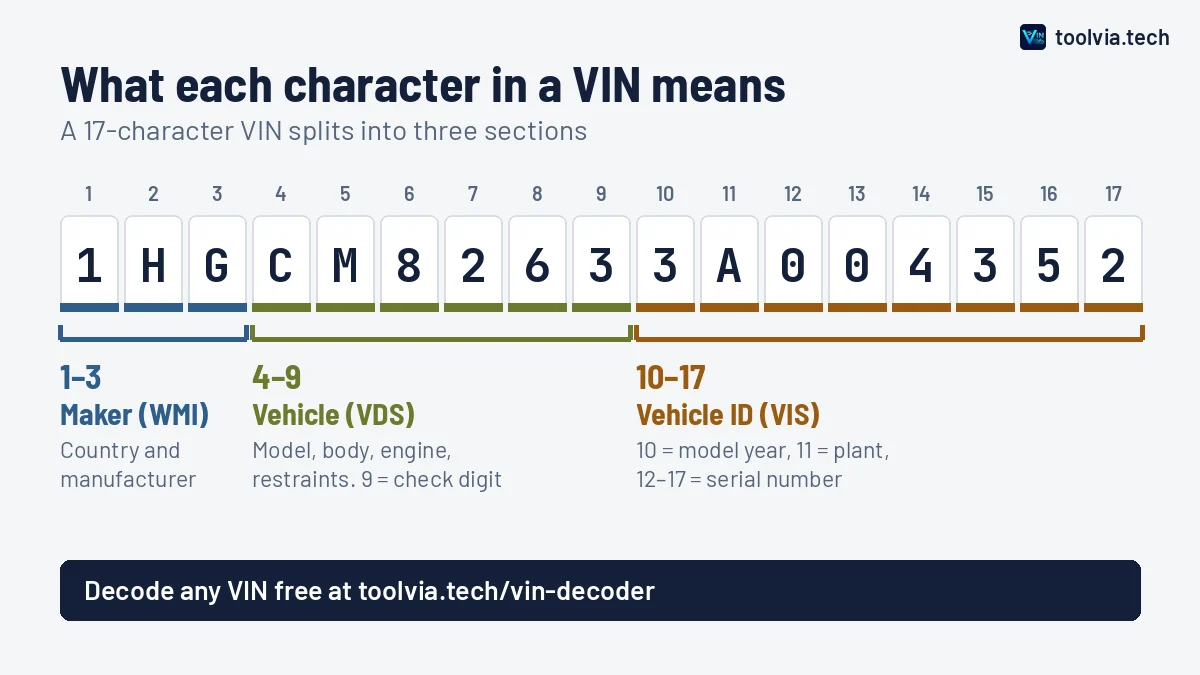
A plain-English guide to all 17 characters of a VIN: the maker code, vehicle details, check digit, model year, plant…
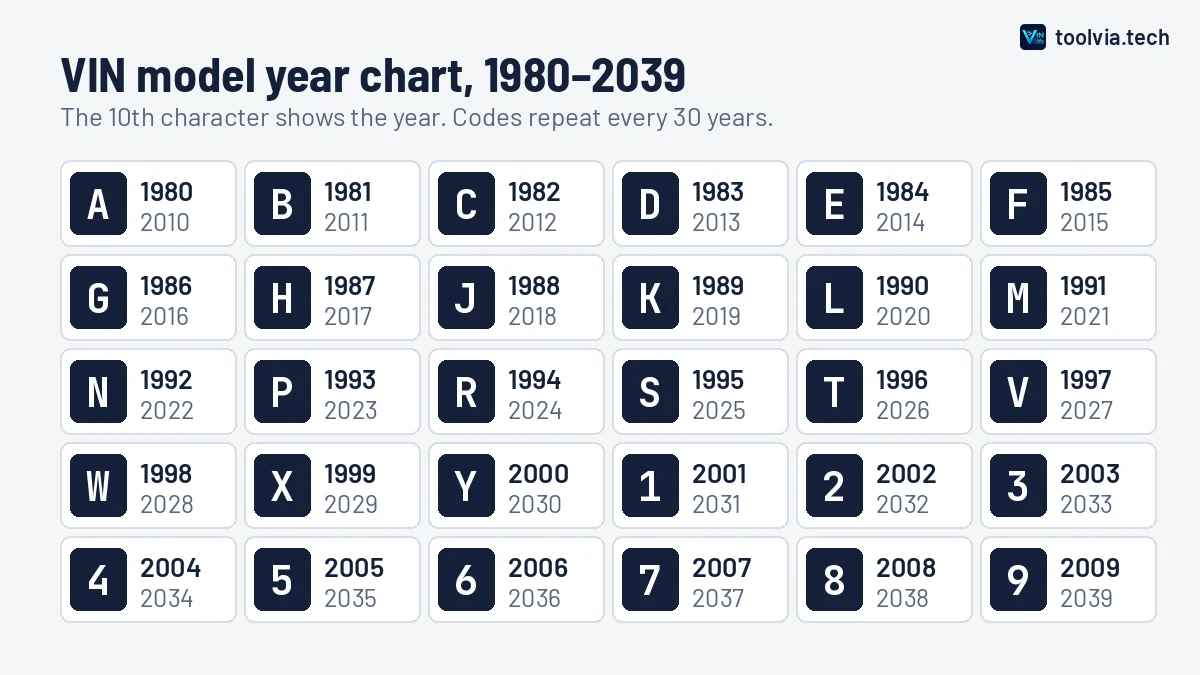
Find any vehicle’s model year from the 10th character of its VIN. A complete chart from 1980 to 2039, plus the simple…
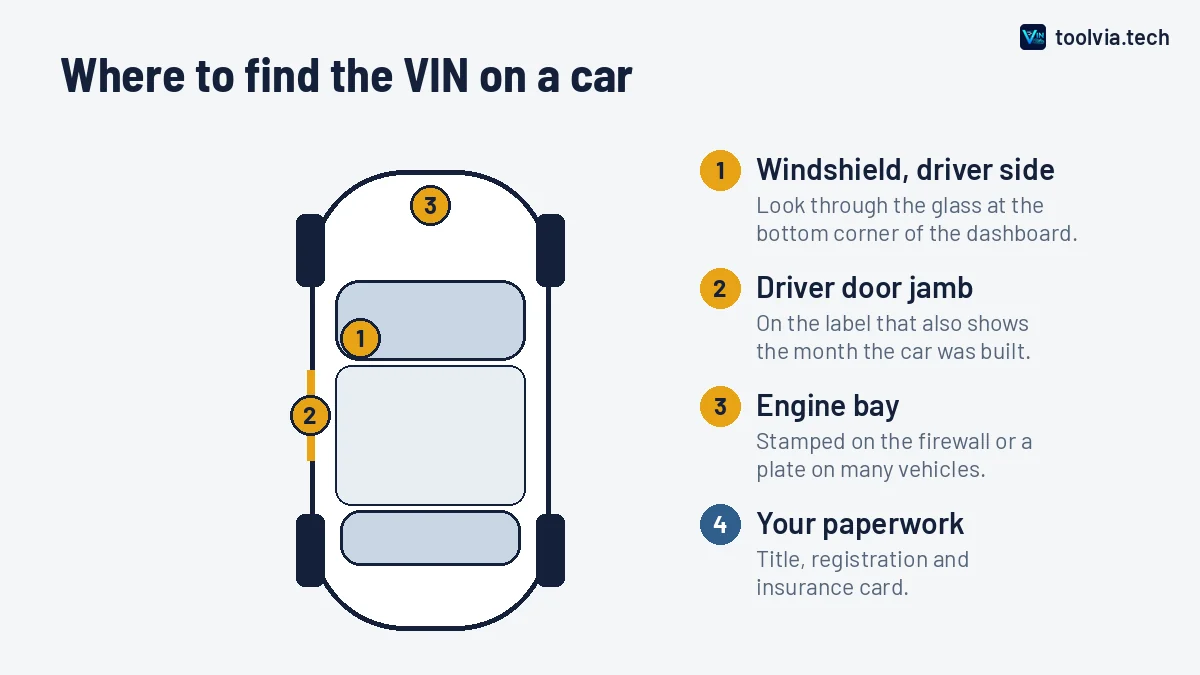
The quickest places to find a VIN on a car, truck, motorcycle, trailer or RV, plus which documents show it and what to…
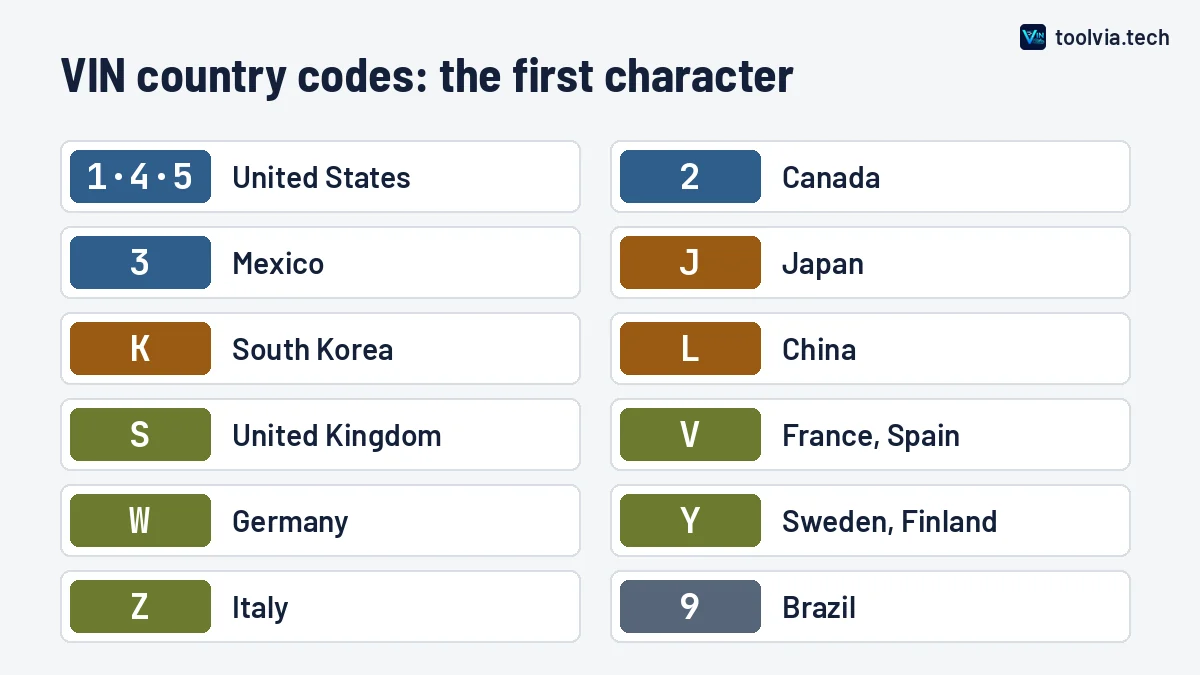
The first character of a VIN shows where a vehicle was built. See the full list of VIN country codes, how the second…
Who uses Toolvia
Used-car buyers check that a car matches its listing and has no open recalls before they go to see it.
Sellers decode their own VIN to write an accurate ad, with the right trim and engine, and share the report link with buyers.
Mechanics and parts counters confirm the exact engine and build year before ordering parts, which saves returns.
Owners check for new recalls on the car they already drive. It takes ten seconds, and recall repairs are free.
Where our data comes from
Every report is built live from public databases run by the National Highway Traffic Safety Administration (NHTSA), the US government agency responsible for vehicle safety. Specs come from the vPIC vehicle catalog, which manufacturers are required to supply. Recalls, owner complaints and crash test ratings come from NHTSA’s safety databases.
We don’t edit the data or fill gaps with guesses. If a detail isn’t on file for your vehicle, the report simply leaves it out. That’s also why some older cars, imports and motorcycles show fewer fields. Read more about how we work.
Frequently asked questions
Is the Toolvia VIN decoder free?
Yes, completely. There’s no signup, no credit card and no daily limit. The data comes from NHTSA’s free public databases, so there’s nothing for us to charge you for.
What will I see after decoding a VIN?
The year, make, model, trim, body style, engine, transmission, drive type and assembly plant, a plain-English explanation of every character, open safety recalls, owner complaints and NHTSA crash test ratings when the model has been tested.
Does it show accident history or mileage?
No. Accidents, mileage, owners and title problems come from paid vehicle history reports. A VIN decoder shows how the vehicle was built and its official safety records, which is still the best first check.
Which vehicles can I decode?
Cars, trucks, SUVs, vans and motorcycles from the 1981 model year onward with a 17-character VIN. Coverage is best for vehicles sold in the United States, because the data comes from NHTSA.
Is it safe to enter a VIN online?
Yes. A VIN identifies a vehicle, not a person, and it’s visible through the windshield of every car on the street. It can’t be used to find the owner’s name or address.
Why does the decoder say my check digit doesn’t match?
Most often a character was mistyped, so compare it with the VIN on the car again. Vehicles built for markets outside North America sometimes don’t use the check digit, so a mismatch there isn’t automatically a problem.
Can I decode a VIN from my phone?
Yes. The site works on any phone or tablet. You can also copy the link to a report and send it to someone, which is handy when you’re looking at a car with a friend or a mechanic.
How often is the data updated?
Every lookup is made live against NHTSA’s databases, so new recalls and complaints show up as soon as NHTSA publishes them.